


What is Pilgrimage?
Pilgrimage is the act of journeying to a holy place, with an intention for healing/wholeness.
This is Britain’s indigenous yoga, a technique of physical meditation for the restless seekers of the West, the chasers after Quest and Odyssey. Pilgrimage is a ritual short-form of our whole life journey, made in the hope that by going a short way well, we might put in better footing our longer path.

Bipedalism – walking on two feet - is our species’ original advantage, the biological life-hack that cast us as upright strollers of the monkey family. Having sourced this technology of walking, for two million years our ancestors were nomadic, roaming the planet in reverent pursuit of the herds and seasons. Constant movement shaped human evolution, creating the bodies and minds we’ve inherited today. Yet a mere twelve thousand years ago, humanity ceased roaming to cultivate agriculture and raise static dwellings (arguably a bad move, leading to general imbalance). As an activity distinct from settled lives, modern pilgrimage arose in response to the end of nomadism, providing ritual reconnection with our ancient wandering freedom, to keep alive the strength and wisdom of humanity’s nomadic roots.

The basic technique of pilgrimage is fourfold:
1. Intention
2. Destination
3. Gift
4. Journey
The first step is to heed the call. It can be ferociously easy in modern life to be pushed along by the normal forces of work, family and friends. Pilgrimage provides an opportunity and challenge to reclaim your personal autonomy, to plant a staff in the river and stride upstream toward your hope of wholeness.
A pilgrimage intention comes in two steps - first the intent to make the journey, and second the specific healing need you seek. Making this hope conscious, as words you can repeat, releases it from your mind into the world, and allows it to have life beyond you. This transforms your hope into prayer, mantra and magic spell.

Next comes destination, the holy place toward which you choose to walk. This can be anywhere that you feel offers the wholeness you seek. Perhaps this will be somewhere very personal, the burial place of an ancestor or a site of a childhood memory. Or maybe you’ll seek somewhere more universally well-known. Certain places in this land have been sought by seekers for hundreds of generations. Holy wells, cathedrals, ancient trees – these spots hold deep dreams, where echoes linger from those whose journeys went before.
Delve to find the place you believe best offers the fulfilment of your intention. You likely already know where it is, the holy place you long for.
Next, the gift. This is what a pilgrim offers in exchange for the blessing they seek. The ancient law of balance requires that giving and receiving go hand in hand, so if you seek something wonderful, you need to offer something too.
Lastly comes the journey. It is my belief that this is almost always best made by walking, without mechanical support, in an unbroken flow of footsteps. A journey on foot is a cumulative endeavour, the sum of every step, every effort, every mile, every day. If you walk, you truly arrive, wherever you get to.
Among this sacred journey unexpected things shall arise: strange meetings, synchronicities and discoveries. Don’t expect to return home the same person. Or rather, expect to be more you than ever before. As the path unfolds outward through nature, so mirrored doors curl inward to reveal aspects of yourself long unseen/ignored.
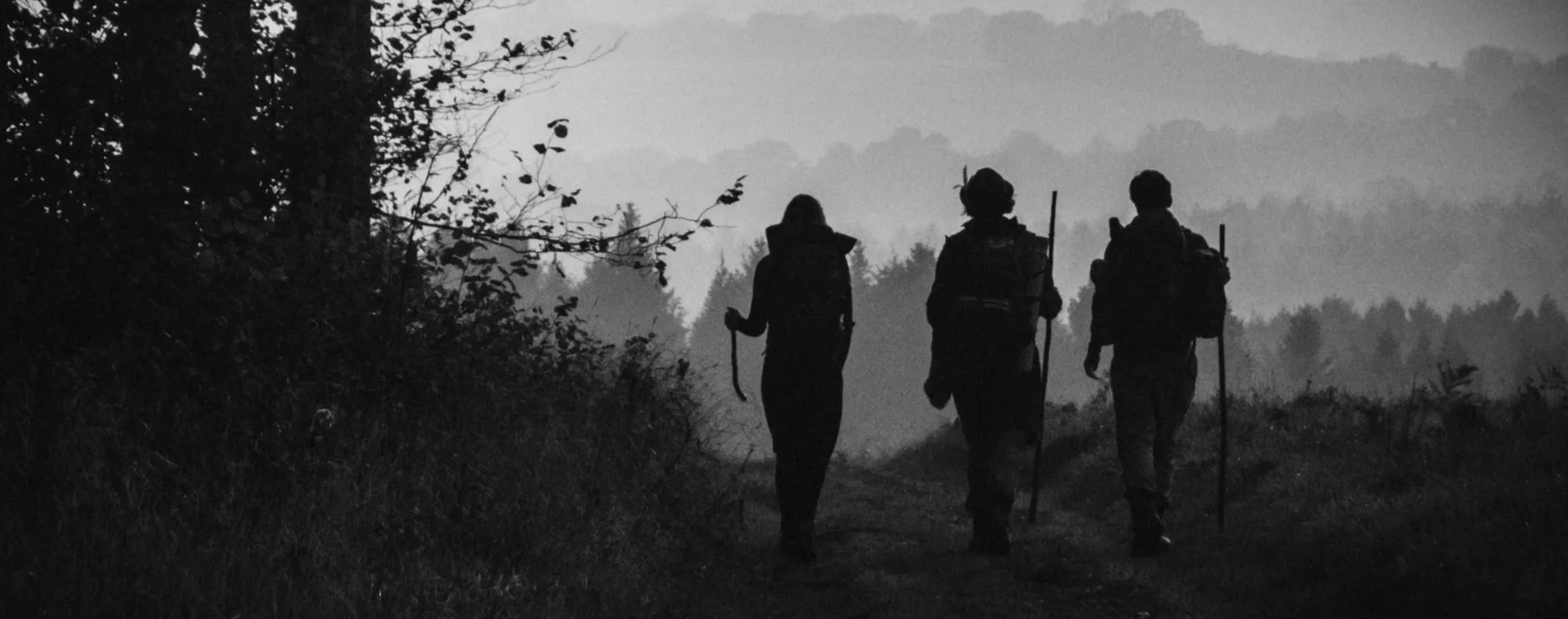
With its source in ancestral Ice Age migration and hunter-gathering, pilgrimage is a practice older than some hills. Not even the combined assault of Kings or industrialists could kill it.
But for the last 500 years pilgrimage has slumbered in Britain. This fallow period has given us an opportunity today to renew pilgrimage as a modern spiritual practice, an open shared inheritance, to make as we need. Pilgrimage today is free for the dream.
Long after the last metal box has stuttered to a stop, humans will continue walking toward our hopes of wholeness. And it will be glorious, slow and simple, and it never stopped.
I hope to see you on the path.
Walk Well!
Back to Home
Back to About British Pilgrimage
